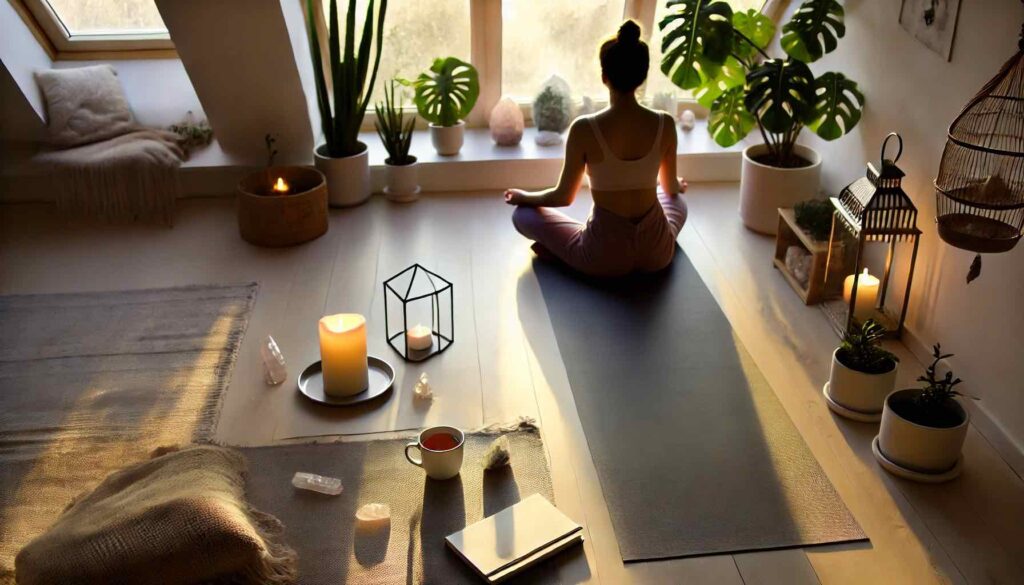
A sound bath is a group session in which you lie on the floor while a facilitator plays singing bowls, gongs and chimes around you — and what it reliably does to your nervous system is trigger a relaxation response: slower breathing, lower muscle tension, a measurable shift toward parasympathetic activity in most people who report enjoying it. What it does not do, despite what a lot of pages will tell you, is repair DNA, cure anxiety, or “retune your cells.” This article draws a clean line through every claim: this is measured, this is plausible but thinly evidenced, this is tradition and symbol, this is simply false.
One thing to state plainly at the top: a sound bath is a relaxation practice, not a treatment for any diagnosed physical or mental health condition. If you are managing anxiety, depression, PTSD, insomnia or anything else, treat this as a complement to professional care, never a replacement for it. Nothing here is medical advice.
What a Sound Bath Actually Is (and What It Isn’t)
You arrive at a studio, take off your shoes, and lie down on a yoga mat with a blanket. For roughly 45 to 75 minutes, someone plays instruments — usually metal or quartz bowls, often a gong, sometimes chimes and a voice — while you do nothing at all. There is no choreography, no chanting along, no posture to hold. The word “bath” is metaphorical: you are not submerged in anything, you are lying still in a room where sound is the only thing happening.
What it isn’t: a diagnostic process, a clinical treatment, or anything with a licensing body behind it. Sound bath facilitation is an unregulated field. There is no standard qualification, no protected title and no required training hours. Two people charging the same price can have wildly different levels of skill and judgment.
The broader tradition of sound as a contemplative tool is genuinely old and genuinely global — nada yoga in the Indian tradition treats sound as a path of absorption, and overtone chanting appears in Tibetan Buddhist and Mongolian practice. Modern sound healing borrows the vocabulary of those systems while running on a much newer format. That is worth knowing before you meet the physiology claims, and it puts sound baths in the same broad family as other sacred healing practices that alter your nervous system — practices with real effects and real histories that are often described with borrowed language.
Sound Bath vs. Sound Healing vs. Music Therapy
- Sound bath — the specific format: a passive, lying-down group session built around sustained tones.
- Sound healing — the umbrella term for any practice using sound therapeutically, including one-to-one vibrational sound therapy with bowls placed on the body, tuning forks, and voice work.
- Music therapy — a regulated clinical profession. In the US, board-certified music therapists (MT-BC) complete an approved degree, supervised clinical hours and a national exam, and work toward defined treatment goals in hospitals and care settings.
That last distinction is the whole sound bath vs music therapy difference: one is a wellness experience, the other is a credentialed clinical discipline. Facilitators who blur the two are overstating what they do.
The Instruments: Where They Come From and What They Do
Himalayan Metal Bowls: Old Objects, Much Newer Practice
Hand-hammered metal bowls from Nepal, Tibet, Bhutan and northern India are real objects with a long history — and the honest version of that history is messier than the marketing. The bowls themselves are documented across the Himalayan region for generations, but the historical record largely supports their use as household and ritual vessels: for food, for offerings, for storage. There is no strong documentary evidence that Tibetan monastic tradition used them as healing instruments in the way Western practitioners do today.
The practice of laying someone down and playing bowls at them for an hour appears to be a twentieth-century Western development, popularised from roughly the 1970s onward as the instruments entered the export market. This is not a reason to dismiss the bowls. It is a reason not to sell a modern practice as an unbroken lineage. Calling a bowl “Tibetan” is a trade convention, not a provenance claim — most bowls sold today are made in Nepal or India for the wellness market.
Crystal Quartz Bowls: A 1980s Invention
The frosted white bowls you see in most studio photos are not ancient anything. They are made from fused quartz and, by widely reported accounts, emerged commercially in the 1980s, with the manufacturing technique connected to crucibles developed for the semiconductor industry. They produce a very pure, sustained, almost piercing tone with fewer competing overtones than hammered metal.
The practical crystal singing bowl vs tibetan bowl difference comes down to texture: quartz gives you one clean sustained pitch that fills a room and can genuinely hurt sensitive ears at close range; metal gives you a complex, wobbling cluster of overtones that decays faster. Neither is more “authentic” — one is just considerably older as an object.
Gongs, Chimes, Tuning Forks and the Human Voice
The gong is the loudest thing in the room and the reason seat choice matters. Chinese gong-making traditions go back centuries, and the large symphonic and “planetary” gongs used in gong bath sessions are modern instruments built on that craft. At full volume, a gong at close range is physically loud — a pressure you feel in the sternum. Some people find that thrilling; others find it genuinely uncomfortable, and that reaction is not a failure of openness.
Koshi chimes — small tuned bamboo wind chimes — are used as the soft landing at the end. Tuning fork therapy applies weighted forks to the body or near the ears; the vibration is pleasant and the clinical evidence is essentially absent. And the human voice, through overtone chanting or simple sustained humming, is the only instrument you already own.
| Instrument | Documented origin & era | Sound character | Role in a session | Evidence status |
|---|---|---|---|---|
| Himalayan metal bowls | Himalayan region; bowls long-documented, therapeutic use largely 20th-c. Western | Complex overtones, low-to-mid, fast decay | Main body of the session; sometimes placed on the body | Nearly all published sound-bath research uses these — and it is weak |
| Crystal quartz bowls | Commercially developed c. 1980s, fused quartz | Pure sustained tone, mid-to-high, very loud | Layered drones, emotional peaks | Essentially no direct published research |
| Gongs | Chinese metallurgical tradition, centuries old; symphonic gongs modern | Broadband, chaotic, extremely loud | Climax of the session, 10–15 minutes in the middle | No controlled evidence; loudness is the main safety issue |
| Chimes (koshi, bar) | Contemporary manufacture | High, sparse, delicate | Opening and closing transitions | None specific |
| Tuning forks | Invented 1711 as a tuning device | Single clean pitch, felt as vibration | One-to-one bodywork, near ears or joints | No credible clinical evidence for therapeutic claims |
| Human voice | Ancient and universal; nada yoga, overtone chanting | Whatever you can produce | Humming, toning, group vocalising | Slow-exhale vocalisation has better physiological rationale than any bowl |
What Actually Happens in Your Nervous System — and What the Evidence Really Shows
The Parasympathetic Shift: What Gets Measured, and How Reliably
Here is the mechanism that is not controversial. You lie down. You stop moving. The lights go low. Your breathing lengthens and your exhale gets longer than your inhale. Longer exhales slow the heart rate through normal respiratory sinus arrhythmia, and sustained slow breathing shifts the autonomic balance toward the parasympathetic nervous system — the “rest and digest” branch. That is textbook physiology and it happens whether the soundtrack is a quartz bowl or rain on a roof.
The most-cited study here is Goldsby et al., an observational study of singing bowl sound meditation with roughly 62 participants, which reported reductions in self-reported tension, anger, fatigue and depressed mood after sessions. It is worth reading fairly and worth reading precisely: it was uncontrolled and observational. No blinding, no active comparison group, self-report outcomes, and participants who had chosen to attend a sound meditation. It shows that people feel better afterward. It cannot show that the bowls caused it.
The confounds are not minor footnotes — they are the main event:
- No active control. Lying still in a dark room for an hour is itself a potent relaxation intervention.
- Expectation. You cannot blind someone to a gong. People who pay for and anticipate relaxation report relaxation.
- Self-selection. The people in these studies already like sound baths.
- Self-report. Mood questionnaires immediately after a pleasant experience are the softest possible outcome measure.
The Stanhope & Weinstein systematic review of the human health effects of singing bowls looked across the available literature and concluded, in effect, that the evidence base is weak and the studies are at high risk of bias. That is the honest headline answer to is there scientific evidence sound baths work: there is evidence that people feel better; there is not good evidence that the sound is the active ingredient. You can search the primary records yourself through the PubMed biomedical literature database.
The Vagus Nerve: Real Anatomy, Stretched Conclusions
The anatomy is real. The auricular branch of the vagus nerve (Arnold’s nerve) supplies sensation to part of the outer ear — the concha and a portion of the external ear canal. This is genuine, and it is why transcutaneous auricular vagus nerve stimulation devices place electrodes on the ear.
Now the honest part. Innervation of the outer ear by a vagal branch is not evidence that a gong stimulates the vagus nerve. Electrical stimulation of a nerve ending and airborne sound reaching an eardrum are different physical events. There is no good human evidence that acoustic exposure activates the auricular vagal branch in any therapeutically meaningful way. Claims about sound bath vagus nerve stimulation take a true anatomical fact and attach an unproven mechanism to it.
What probably is improving vagal tone during a session is the slow breathing, the supine position and the absence of demand — measurable via heart rate variability, and achievable by several cheaper routes. On cortisol: some small studies report reductions after relaxation-based sound sessions, but cortisol swings on a steep daily curve and is highly sensitive to timing, making single before-and-after measurements hard to interpret. Treat “sound baths lower cortisol” as plausible and under-evidenced, not established.
Alpha, Theta and Delta: Brainwave Entrainment Is Thinner Than You’ve Read
You will read that bowls “entrain your brain into theta.” The underlying idea — that rhythmic sensory input can pull neural oscillations toward its frequency — is a real phenomenon in neuroscience, mostly studied with steady, precisely controlled stimuli. Whether an improvised layering of bowls achieves anything of the kind is a different question, and the answer is that it has barely been tested.
What we can say: alpha activity (roughly 8–12 Hz) rises when you close your eyes and relax, theta (4–8 Hz) appears in drowsiness and the edge of sleep, and delta (under 4 Hz) dominates deep sleep. During a sound bath many people drift to the theta boundary and some fall fully asleep — but that is the state, not proof of what caused it. The best-studied adjacent area is binaural beats, and the Garcia-Argibay et al. meta-analysis on binaural auditory beats for anxiety, cognition and pain found effects that were small and heterogeneous across studies. Small and inconsistent is a long way from “entrainment.”
Anxiety, Depression and Sleep: What We Can and Can’t Say
The National Center for Complementary and Integrative Health takes a broadly consistent line on music-based and mind–body interventions: there is reasonable support for short-term reductions in stress and anxiety in some contexts, and considerably less for treating diagnosed disorders. Applied to sound therapy for stress, that means: defensible — temporary reduction in subjective stress and tension. Not defensible — treating an anxiety disorder, depression or clinical insomnia.
For contrast, here is what a sound-related practice with real controlled evidence looks like: Puhan et al., published in the BMJ in 2006, ran a randomised trial of didgeridoo playing for obstructive sleep apnoea and found improvement in daytime sleepiness and apnoea severity. Note the shape of that claim — a specific instrument, a specific mechanism (training the upper airway muscles), a randomised design, and a narrow conclusion. That is the standard sound baths have not yet met.
The 528 Hz ‘Miracle Frequency’: Why It Doesn’t Hold Up
What the 528 Hz Studies Actually Measured
The claim: 528 Hz is the “love frequency” or “miracle tone,” one of the Solfeggio frequencies, and it repairs DNA. Two studies get cited for it, and both deserve a fair description.
Babayi & Riazi exposed human astrocyte cells in culture to 528 Hz sound and reported an effect on cell death in ethanol-treated cells. That is an in vitro study — cells in a dish, not people — with the small scale typical of exploratory cell work. Akimoto et al. examined 528 Hz music and endocrine and autonomic markers in roughly nine participants. Nine. A group that size can suggest a direction for future research; it cannot establish a physiological effect.
Neither study measured DNA repair. Neither could. The 528 hz frequency dna repair debunked summary is short: there is no proposed mechanism by which airborne sound at 528 Hz would repair DNA, and no human evidence that it does. Not “unproven.” Not “some believe.” False.
For context on the number itself, there is nothing acoustically special about it. 528 Hz sits almost exactly on the musical note C5 — a standard-tuned piano’s C above middle C rings at 523.25 Hz, so 528 Hz is that same pitch, a shade sharp. You hear frequencies in that range constantly: a soprano’s high notes, a doorbell, half the melody line of most pop songs on the radio. The number itself carries no unique physical property, and a bowl tuned to 528 Hz behaves acoustically exactly like a bowl tuned to 519 Hz or 540 Hz.
The full Solfeggio set — usually given as 396, 417, 528, 639, 741 and 852 Hz — is not a scientific series either. Its popular origin traces to a numerological reading of a Latin hymn text, “Ut queant laxis,” in which each syllable (Ut, Re, Mi, Fa, Sol, La) is assigned a number through gematria and then reduced by digit-summing. That is a symbolic exercise applied to medieval liturgical Latin, not a measurement of anything physical. Puleo and Horowitz took this exercise and layered modern claims about cellular repair and “solar harmonics” on top of it decades later.
How the Claim Spreads: A Concrete Example
The pattern shows up clearly in the wider “water memory” literature that 528 Hz marketing often leans on. Masaru Emoto’s widely circulated water-crystal photographs claimed that water exposed to certain sounds, words or intentions — 528 Hz among them — formed more symmetrical ice crystals than water exposed to negative stimuli. The photography was never done under blinded conditions, crystal selection was never controlled for, and the work has not been replicated in a peer-reviewed setting. It is a template you’ll see repeated across sound-healing marketing: a striking image or a real-sounding scientific term, attached to an experiment nobody else can reproduce. If a page selling a 528 Hz track cites water crystals or “DNA activation” as proof, treat that as a signal to stop reading the science claims — and just enjoy the music if you like the sound of it.
The One Genuine Exception: Frequency-Matched Sound for Tinnitus
There is a real, moderately evidenced case where a specific frequency does matter to the person listening — but it isn’t 528 Hz, and it isn’t universal. In notched sound therapy for tinnitus, an audiologist first measures the exact pitch of a person’s ringing, then filters a narrow band centred on that pitch out of music the person listens to regularly. Some controlled trials report a modest reduction in tinnitus loudness over months of consistent use. The proposed mechanism is lateral inhibition in the auditory cortex, not resonance or cellular repair, and the frequency removed is different for every person because it’s derived from their own hearing test. That is the shape a real frequency-specific effect takes: personalised, mechanistically plausible, modestly evidenced — the opposite of a single number marketed as universal medicine for anyone who plays it.
Why a Frequency Claim Doesn’t Have to Be True to Be Useful
If you have a 528 Hz track you love, keep it. Choosing a specific sound, naming why, and returning to it deliberately is a legitimate intention-setting act — the same mechanism behind any ritual object. A cue that consistently precedes rest becomes a conditioned signal for rest. That is real, and it is enough. It just isn’t molecular biology, and no one selling it should imply otherwise.
Your First Sound Bath, Minute by Minute
Here is what a standard 60-minute studio session looks like from the inside, with a 7:00pm start.
- 6:50pm — arrive. Studios usually ask for ten minutes early, partly so latecomers don’t walk in during the quiet. Choose a mat near the wall, not the centre: the gong is loudest in the middle of the room. Take socks. Floors get cold and you will notice by minute forty.
- 7:00 — opening. The facilitator gives a short intention and asks the room about pregnancy, tinnitus and hearing sensitivity. Answer honestly; this is the moment to say you’d rather be further from the gong.
- 7:05 — settling. Lie down under a blanket with an eye pillow. Take three long exhales — this is the part actually doing the physiological work.
- 7:10–7:35 — bowls layer in. Your mind will wander roughly every ninety seconds. That is normal and not failure. Some people are bored here. Some are restless and want to check the time. Both are common.
- 7:35–7:45 — the gong builds. You may feel buzzing in the hands, a wave of sudden emotion, or the urge to cry. You may also fall asleep and miss it entirely. All of these are ordinary.
- 7:45–7:55 — thinning out. Chimes, then silence. The silence after the last bowl is the part most people remember.
- 8:00 — sit up slowly. Standing too fast after an hour flat leaves people light-headed. Drink water before you drive.
And if you felt nothing? That happens, and it doesn’t mean you did it wrong. Roughly the same principle applies as with creating a sacred space for relaxation practices — the setting does a lot of the work, and the effect builds across repetitions rather than arriving all at once.
What to Bring, What to Wear, What It Costs
Bring socks, a jumper, your own blanket if you run cold, and water. Wear anything you’d sleep in — no waistbands that dig in when you’re flat for an hour. Most studios supply mats, bolsters and eye pillows, but confirm when you book. Prices vary widely by city; group sessions typically sit in the low-to-mid two figures, with one-to-one vibrational sessions costing considerably more.
Who Should Check With a Doctor First
Most cautions here are precautionary convention among facilitators rather than evidence-based restrictions — worth saying plainly. Talk to a clinician first if any of these apply:
- Tinnitus or hearing sensitivity — the most evidence-relevant caution, because gongs and quartz bowls genuinely reach high sound levels. Sit far from the gong or skip it.
- Epilepsy or a seizure disorder — precautionary, but discuss it first.
- Pregnancy — most facilitators avoid placing bowls directly on the body and will move you away from the gong. This is convention, not established risk.
- Implanted devices such as a pacemaker or cochlear implant, and recent surgery — avoid bowls placed on the body.
- PTSD or dissociative symptoms — lying still in the dark with intense sound can be destabilising for some people. Sit near the door.
- Severe migraine or vertigo — sustained loud tones can trigger episodes.
Common side effects are mild and short-lived: light-headedness on standing, a headache from volume, tearfulness, or feeling groggy for an hour afterward.
A 15-Minute Sound Practice You Can Do Tonight
This is a sound bath at home for beginners protocol — a compressed version of the studio arc, and the parts with the best physiological rationale are the breathing and the silence, not the audio.
- Minutes 0–2 — set up. Phone on aeroplane mode, one lamp or none, a blanket, a folded towel under your knees. Lie on your back on the floor, not the bed.
- Minutes 2–4 — breathe. Inhale for a count of four, exhale for a count of eight. Ten rounds. The long exhale is what shifts autonomic balance; everything after this is atmosphere.
- Minutes 4–10 — sound. Play one continuous bowl or gong recording at low volume — you should be able to hear your own breathing over it. One track, no shuffle. Let your attention drift; when it wanders, return to the sound without grading yourself.
- Minutes 10–13 — fade. Turn the sound off and stay exactly where you are. This is the equivalent of the studio’s final ten minutes and it is the part most people skip.
- Minutes 13–15 — return. Roll to one side, wait thirty seconds, then sit up. Write one line about how you feel — a single sentence is enough to track whether this is doing anything for you over a month.
If You Only Have Your Voice
Sit upright, inhale normally, and hum a comfortable low note for the entire exhale. Do it twelve times. Humming forces a long, controlled exhale and adds vibration in the chest and throat — mechanically the closest home version of what a bowl is supposed to be doing, and it costs nothing.
How Often Is Actually Worth It?
Studio sessions once or twice a month is a realistic rhythm for most people; more often than weekly rarely adds much, and there is no evidence base establishing an optimal dose. The home practice is different — five to fifteen minutes most evenings beats one dramatic session a quarter, which is the general pattern with making wellness practices part of your daily routine. Some people prefer anchoring sessions to ritual practices synchronized with natural cycles, which is a scheduling device rather than a physiological one — and a perfectly good one, because a practice you remember to do outperforms a better practice you forget.
What to Do Now
- Tonight: run the 15-minute protocol above with any bowl recording at low volume. Write one sentence afterward.
- This week: search for a local studio session and read the booking page for the words “arrive 10 minutes early,” a stated contraindications question, and a clear price. Absence of all three is a signal.
- Before you book: email the facilitator two questions — how loud the gong gets, and whether you can position yourself away from it. A good facilitator answers both without defensiveness.
- At your first session: take socks, arrive at 6:50 for a 7:00 start, take a mat by the wall, and disclose tinnitus or pregnancy in the opening round.
- Over four weeks: do the home practice at least four evenings a week and keep the one-line log. Judge the practice on that record, not on a single session.
- If you are treating a diagnosed condition: tell your clinician you are adding this, and keep every existing treatment exactly as it is.
Frequently Asked Questions
What actually happens to your nervous system during a sound bath?
Lying still, breathing slowly and closing your eyes shifts autonomic balance toward the parasympathetic branch, lowering heart rate and muscle tension. That relaxation response is well established. What remains unproven is whether the sound itself, rather than the stillness and slow breathing, is the active ingredient.
Is there scientific evidence that sound baths work?
There is weak evidence. Goldsby et al.’s observational study of about 62 participants reported improved mood and reduced tension, but it was uncontrolled. Stanhope and Weinstein’s systematic review of singing bowl health effects concluded the evidence base is weak and at high risk of bias.
How do sound baths affect the vagus nerve?
The auricular branch of the vagus nerve does supply part of the outer ear, but that anatomical fact is not evidence that airborne sound stimulates it. Any improvement in vagal tone during a session most likely comes from slow breathing and lying still, not from the instruments.
Can sound healing lower cortisol and stress hormones?
Some small studies report cortisol reductions after relaxation-based sound sessions, but cortisol follows a steep daily curve and single before-and-after measurements are hard to interpret. Treat cortisol reduction as plausible and under-evidenced rather than established, and note that any deep-rest practice may do the same.
Does 528 Hz repair your DNA?
No. There is no proposed mechanism by which airborne sound at 528 Hz would repair DNA and no human evidence that it does. The claim traces to Puleo and Horowitz’s 1999 trade book, not peer-reviewed research. Cited studies used cell cultures or roughly nine participants.
What brainwave states happen during a sound bath?
Most people move into alpha activity when relaxing with eyes closed, and some drift toward theta at the edge of sleep or into delta if they fall fully asleep. That reflects the state of rest itself; evidence that bowls entrain brainwaves specifically is very thin.
What is the difference between a sound bath and sound healing?
A sound bath is one specific format: a passive group session where you lie down while instruments are played. Sound healing is the umbrella term covering all therapeutic sound use, including one-to-one bodywork and tuning forks. Neither is the same as board-certified music therapy.
How often should you do a sound bath?
Once or twice a month works for most people at a studio, though no research establishes an optimal frequency. A short daily home practice of five to fifteen minutes delivers more cumulative benefit than occasional long sessions, because consistency matters more than intensity for relaxation practices.