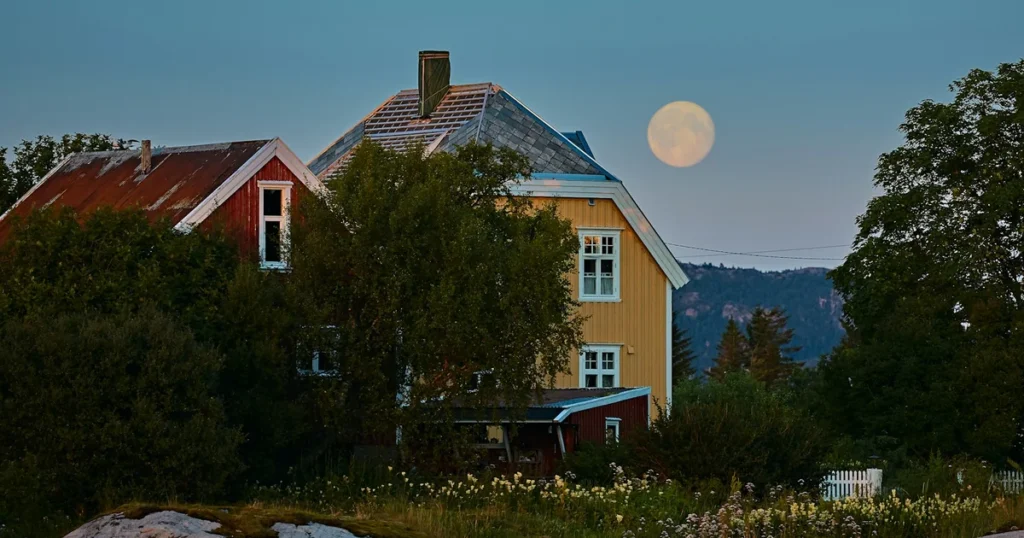
The twelve traditional full moon names are, in order: Wolf Moon (January), Snow Moon (February), Worm Moon (March), Pink Moon (April), Flower Moon (May), Strawberry Moon (June), Buck Moon (July), Sturgeon Moon (August), Corn Moon (September), Hunter’s Moon (October), Beaver Moon (November) and Cold Moon (December). Each name describes something that was happening in nature or in human work at that time of year in northeastern North America — not a mystical property of the moon itself.
Below you’ll find the full reference table, the honest story of where these names actually come from (it is not one single tradition), and one concrete ritual idea for every moon.
- The 12 names at a glance · Where the names come from
- January · February · March · April · May · June · July · August · September · October · November · December
- Supermoon, blue moon, blood moon · How to use these names · Honest caveats · FAQ
The 12 Full Moon Names at a Glance
A full moon happens when the Earth sits between the sun and the moon, so the whole lunar disc we can see is lit. That alignment repeats every 29.53 days — the synodic or lunar month — which gives us twelve or occasionally thirteen full moons in a year. The table below gives you the full moon names in order by month, their alternates, and — the part most articles skip — which tradition each name actually comes from.
| Month | Moon Name | Common Alternate Names | Origin Tradition | What the Name Refers To | One-Line Ritual Idea |
|---|---|---|---|---|---|
| January | Wolf Moon | Great Spirit Moon, Center Moon, Cold Moon (some nations) | Colonial American / English, with Algonquian parallels | Wolves heard more often in deep winter | Name what winter has cost you and what you’re keeping warm for |
| February | Snow Moon | Hunger Moon, Bone Moon, Bear Moon | Colonial American, recorded from Algonquian sources | Heaviest snowfall month in the Northeast | Write down one thing you’re rationing — time, money, energy |
| March | Worm Moon | Sap Moon, Crow Moon, Lenten Moon | Colonial American; Lenten Moon is English/Christian | Thaw softening the ground; larvae emerging from bark | List one thing that survived the winter and needs light |
| April | Pink Moon | Sprouting Grass Moon, Egg Moon, Paschal Moon | Colonial American; Paschal Moon is Christian/European | Moss phlox, an early pink wildflower | Plant something literal — seeds, a cutting, a bulb |
| May | Flower Moon | Corn Planting Moon, Milk Moon, Hare Moon | Algonquian-attributed; Milk Moon is Old English | Peak wildflower bloom | Say out loud what you want to grow this year |
| June | Strawberry Moon | Rose Moon, Honey Moon, Mead Moon | Algonquian; Rose and Mead Moon are European | Short wild strawberry harvest | Eat something seasonal slowly and deliberately |
| July | Buck Moon | Thunder Moon, Hay Moon, Salmon Moon | Colonial American / Algonquian-attributed | New antlers pushing out on male deer | Write one thing you’re growing that isn’t finished yet |
| August | Sturgeon Moon | Green Corn Moon, Grain Moon, Ricing Moon | Algonquian peoples of the Great Lakes | Lake sturgeon most easily caught | Take stock of what’s already abundant in your life |
| September | Corn Moon | Harvest Moon, Barley Moon, Autumn Moon | Algonquian (Corn); Harvest Moon is English | Corn ripening; bright evening light for harvesting | Count one thing you finished this year, in writing |
| October | Hunter’s Moon | Dying Grass Moon, Travel Moon, Sanguine Moon | English/European | Clear fields and bright nights for hunting game | Decide what you’re actively pursuing before year-end |
| November | Beaver Moon | Frost Moon, Freezing Moon, Digging Moon | Colonial American fur-trade era | Beavers building lodges; last traps before freeze-up | Do one concrete task that prepares you for winter |
| December | Cold Moon | Long Nights Moon, Moon Before Yule, Little Spirit Moon | Mohawk-attributed; Yule name is Old English | Onset of true winter and longest nights | Write what you’re carrying into the new year and what you’re not |
Where Full Moon Names Actually Come From (and the Myth Worth Correcting)
The short answer to where do full moon names come from: they are a mixed set, assembled and popularised in print. Most of the list as English speakers know it was published by The Old Farmer’s Almanac from the 1930s onward, presented as “Indian” moon names. The almanac drew mainly on Algonquian-speaking peoples of the northeastern United States — a language family that includes the Lenape, Narragansett, Wampanoag, Abenaki and others — filtered through colonial-era English writers.
That matters, because the single most repeated claim about these names is also the least accurate. There is no unified “Native American moon calendar.” There are hundreds of distinct Indigenous nations in North America, speaking dozens of unrelated languages, with their own lunar systems that often disagree with each other.
- Ojibwe (Anishinaabe) moon names are their own system: January is Gichi-manidoo-giizis, the Great Spirit Moon; April is Iskigamizige-giizis, the Maple Sugaring Moon. Neither maps onto “Wolf” or “Pink.”
- Cree names reflect a colder, more northern year, with names built around frost and migrating birds rather than strawberries and phlox.
- Cherokee tradition gives February the Bone Moon — a hunger month when families gnawed bones for marrow.
- English and Anglo-Saxon names sit in the same list without most readers noticing. Harvest Moon and Hunter’s Moon are English agricultural terms. Milk Moon comes from Old English Thrimilce, the month cows were milked three times a day. Moon Before Yule is straight out of the medieval English calendar recorded by the Venerable Bede.
- Colonial American settlers added their own: the Beaver Moon is tied to the North American fur trade, which is an eighteenth-century commercial reality, not an ancient one.
- Celtic and neo-pagan lists (Seed Moon, Hare Moon, Wine Moon) circulate widely online but are largely modern reconstructions with thin historical evidence. Treat them as contemporary practice rather than surviving tradition.
None of this makes the names less useful. It just means the honest framing is: a popular almanac list of seasonal nicknames, drawn from several cultures, some Indigenous and some European. Using them respectfully starts with saying which is which.
Why lunar calendars don’t line up neatly with our months
Twelve lunar months add up to about 354 days, roughly 11 days short of the 365-day solar year. The mismatch drifts, and about every 2.7 years a thirteenth full moon squeezes into the calendar. Many Indigenous systems handled this with 13 moons tied to observable events — first thunder, ice break-up, ricing — rather than fixed dates. Our twelve-name list is a Gregorian simplification of something that was originally more flexible, which is exactly why a moon name can slip a month and why the same moon carries several names.
January: The Wolf Moon
Why is it called the Wolf Moon? The traditional explanation — wolves howling outside villages from hunger in midwinter — is popular but partly folklore. Wolves howl year-round; they simply howl more audibly in January, when they are territorial ahead of the February breeding season and sound carries further over frozen, quiet ground. The name is best documented in Colonial American usage, with a striking parallel in Old English, where January was Wulf-monath, wolf month. Several Algonquian-speaking nations did use wolf imagery for this moon; others did not — the Ojibwe call it the Great Spirit Moon.
The wolf moon meaning people reach for today is about endurance, protection and pack: what you survive, and who you survive it with. Alternate names include Center Moon (Assiniboine, marking the middle of winter), Cold Moon in some nations, and Hard Moon. January’s full moon is also frequently a supermoon or near-supermoon, because lunar perigee often falls close to it in winter — which is why it so often looks unusually large and bright.
Because January opens the year, this moon has become the most searched of the twelve and the natural entry point for anyone starting a moon practice. It is the one we build the worked example around below.
Try this: On the January full moon, step outside for five minutes and name — out loud or on paper — the one thing this winter has cost you most, then write the one thing you are keeping warm for. Keep the note where you’ll find it in February.
February: The Snow Moon
February is statistically the snowiest month across much of the northeastern United States, and the name reflects that plainly. It comes to us through Colonial American records citing Algonquian sources. The grimmer alternate names tell you more: Hunger Moon, because stored food ran low and hunting was hardest, and the Cherokee Bone Moon.
The meaning attached to this moon is scarcity handled well — not romantic hardship, but the practical business of getting through with less. Some nations call it the Bear Moon, marking when cubs are born in the den.
Try this: Write down one thing you are currently rationing — money, time, patience, energy — and one small way you could stop rationing it by spring.
March: The Worm Moon
The standard explanation is earthworm casts appearing as the ground thaws. A better-sourced version traces the name to Captain Jonathan Carver’s 1760s observations among Dakota communities, where the “worms” were beetle larvae emerging from thawing tree bark — a more accurate fit, since earthworms across much of the northern US are introduced European species. Alternates include Sap Moon (maple tapping season), Crow Moon and the English Lenten Moon.
March’s moon means the first visible evidence that the year has turned, before anything looks like spring.
Try this: Name one thing in your life that quietly survived the winter and now needs attention to grow — then schedule the first concrete step for it this week.
April: The Pink Moon
Why is the April moon called Pink Moon — and no, the moon does not turn pink. The name comes from moss phlox (Phlox subulata), also called creeping phlox or moss pink, one of the earliest widespread wildflowers to carpet the ground in eastern North America. The name is Colonial American, recorded alongside Algonquian usage.
Alternates: Sprouting Grass Moon, Egg Moon, and the Paschal Moon — the full moon that fixes the date of Easter, making April’s moon the only one in the list with a formal role in the Christian calendar.
Try this: Plant something real — seeds, a cutting, a bulb in a pot — and write on the label the intention you’re planting with it.
May: The Flower Moon
Peak bloom, and one of the few names where every tradition agrees on the theme. Algonquian-attributed names include Flower Moon and Corn Planting Moon; the Old English Milk Moon comes from Thrimilce, the month when pasture was rich enough to milk cows three times daily.
The meaning is abundance that hasn’t been harvested yet — potential visibly underway.
Try this: Say out loud, to someone or to yourself, one thing you want to grow this year, and put one date in your calendar that moves it forward.
June: The Strawberry Moon
Named by Algonquian peoples for the brief wild strawberry harvest, which lasts only a few weeks in the Northeast. In Europe the same moon was the Rose Moon, Mead Moon or Honey Moon — the last possibly the origin of the word for a post-wedding trip, since June weddings were common.
Because it falls near the summer solstice, the June full moon rides low across the sky and often looks warmly golden near the horizon.
Try this: Eat one seasonal thing slowly and without a screen, and name one pleasure in your life that only lasts a short window.
July: The Buck Moon
Male deer regrow their antlers each year, and by July the new growth is well underway in velvet — the source of this Colonial American name. Alternates include Thunder Moon for July storms and Hay Moon for the first hay cutting. Some Pacific Northwest nations mark it as the Salmon Moon.
The meaning is growth in progress: something visibly forming that is not yet hardened or finished.
Try this: Write down one thing you’re building that is still soft and unfinished, and one thing you’ll stop apologising for about its unfinished state.
August: The Sturgeon Moon
Named by Algonquian peoples of the Great Lakes and Lake Champlain, where lake sturgeon — a fish that can exceed 2 metres and live over a century — were most readily caught in August. This is one of the most clearly Indigenous names in the list, tied to a specific region and species rather than a general season. Alternates: Green Corn Moon, Grain Moon, and the Ojibwe Ricing Moon for wild rice harvest.
Try this: List three things that are already abundant in your life right now, and pick one to share with someone this month.
September: The Corn Moon (and When It Becomes the Harvest Moon)
When is the Harvest Moon — September or October? Both, depending on the year, and the confusion is worth untangling because it trips up almost every list online.
Corn Moon is an Algonquian-attributed name for September’s full moon, marking the ripening and gathering of corn. Harvest Moon is a separate, English term with a precise astronomical definition: it is the full moon falling closest to the autumnal equinox (around 22–23 September). Usually that is September’s moon. But roughly once every three years, October’s full moon lands nearer the equinox and takes the title instead — in which case September keeps the name Corn Moon and October’s moon becomes the Harvest Moon, pushing the Hunter’s Moon into November.
The harvest moon meaning is genuinely practical rather than symbolic. Around the equinox, the moon’s orbit sits at a shallow angle to the horizon, so successive moonrises come only about 25–30 minutes later each night instead of the usual 50. For several evenings running, bright moonlight arrives just as the sun sets — which historically gave farmers extra usable light to bring in crops without lanterns. That effect is real, measurable and the reason the name exists at all.
A concrete example makes the rule easier to hold onto. In 2020, the autumnal equinox fell on 22 September. That year’s September full moon landed on the 2nd — nearly three weeks before the equinox — while October’s full moon fell on the 1st, only nine days after it. October was the closer of the two, so October’s moon carried the Harvest Moon title that year, September’s kept the plain Corn Moon name, and the Hunter’s Moon that would normally sit in October got bumped into November. The same shuffle happened in 2017, when October’s full moon again landed closer to the equinox than September’s did. It’s a small, predictable swap, and it happens whenever that year’s September full moon falls unusually early in the month.
A couple of exceptions are worth knowing too. In a year with a seasonal Blue Moon — the third of four full moons in one season — every name that follows it shifts by one slot, which can push the Corn Moon designation later than a simple month-count would suggest. And the name only makes sense in the climate that coined it: corn in the northeastern US ripens through September, but across much of the Southern Hemisphere the same full moon falls in early spring, so local almanacs there use their own seasonal names rather than importing “Corn Moon” for a month when nothing is being harvested at all.
Other names for this moon include Barley Moon, Autumn Moon and, in some nations, the Moon When the Rice Is Gathered.
Try this: Write down one thing you actually finished this year, however small, and one thing you’re deliberately choosing not to finish — then read both back before you put the list away.
October: The Hunter’s Moon
An English/European name, not an Indigenous one, though it is regularly listed as Native American. Once the fields were cleared after harvest, game had nowhere to hide and the bright post-harvest moon extended hunting hours — the same shallow-orbit effect that makes the Harvest Moon useful continues into October. Alternates include Dying Grass Moon, Travel Moon and the historic Sanguine or Blood Moon — an older European usage referring to slaughter season, entirely unrelated to lunar eclipses.
Try this: Name one thing you are actively pursuing before the year ends, and write the single next action it requires.
November: The Beaver Moon
Two explanations coexist and both are plausible: beavers are visibly busy reinforcing lodges before freeze-up, and trappers set their last traps of the season before waterways iced over. The second explanation places this name firmly in the Colonial American fur-trade era rather than in deep antiquity. Alternates: Frost Moon, Freezing Moon (Anishinaabe) and Digging Moon (Tlingit).
Try this: Do one concrete preparation task tonight — a repair, a stocked cupboard, a scheduled appointment — and note how it changes how the next month feels.
December: The Cold Moon
What does the Cold Moon mean? It marks the arrival of real winter, and the name is attributed to the Mohawk. December’s moon sits high and stays above the horizon longer than any other full moon of the year — up to 15–16 hours at mid-northern latitudes — which is why the alternate name Long Nights Moon is doubly apt. The Old English Moon Before Yule refers to the same moon in an entirely separate tradition, and the Anishinaabe call it the Little Spirit Moon.
The cold moon meaning in modern practice is closure and stocktaking: the year is done, the ground is hard, nothing more is being planted. It pairs naturally with the winter solstice, which falls within days of it.
Try this: Write two short lists — what you are carrying into the new year, and what you are deliberately leaving in this one — and keep only the first.
Supermoon, Blue Moon and Blood Moon: What the Extra Names Mean
These three cluster around the same searches, and the difference between blue moon and supermoon is simply that one is about distance and one is about timing. Plain definitions:
- Supermoon — a full moon occurring near perigee, the closest point in the moon’s slightly elliptical orbit. Perigee is about 356,500 km from Earth; apogee about 406,700 km. A supermoon appears up to 14% wider and around 30% brighter than a moon at apogee. The difference is real but subtle to the naked eye — most of the “huge moon” impression you get is the moon illusion, a perceptual effect near the horizon. The term was coined by an astrologer in 1979, not by astronomers, and there’s no single official threshold; most sources use full moons within 90% of perigee, giving three to four supermoons a year.
- Blue Moon — nothing to do with colour. Two definitions circulate. The seasonal one (the original, from the Maine Farmers’ Almanac) is the third full moon in a season that contains four. The monthly one — the second full moon in a single calendar month — came from a 1946 misreading in Sky & Telescope that stuck. Either way, it happens roughly every 2.5 to 3 years, which is where “once in a blue moon” comes from.
- Blood Moon — the modern meaning is a total lunar eclipse, when Earth passes directly between sun and moon. The moon doesn’t go dark because sunlight bends through Earth’s atmosphere; blue wavelengths scatter away and red ones bend through, painting the disc copper-red. You are effectively watching every sunrise and sunset on Earth projected onto the moon. NASA’s public guides to total lunar eclipse timing and visibility list exact dates and regions for upcoming eclipses.
These labels stack. A super blue blood moon is just a total lunar eclipse that happens to fall on a near-perigee full moon that is also the second in its month — rare as a combination, but each ingredient is ordinary.
Micromoon, Black Moon and other names you’ll see in headlines
A micromoon is the opposite of a supermoon: a full moon at or near apogee, appearing at its smallest and dimmest. A Black Moon is a new moon equivalent of a blue moon — either the second new moon in a calendar month or the third in a season of four; since new moons are invisible, it’s a calendar curiosity rather than something to look at. You’ll also see Harvest Supermoon, Pink Supermoon and similar mashups, which are simply a traditional name plus a distance label.
None of these terms are formal astronomical categories, and headlines routinely oversell them. If a name promises a spectacle, check the actual numbers before setting an alarm.
How to Use the Moon Names in Your Own Practice
The practical value of the names is that they give you twelve scheduled prompts a year, each with a built-in theme drawn from the season you’re actually in. That is a rhythm, not a power source — and it works for the same reason any regular journaling or review habit works. If you want to deepen your full moon practice beyond one evening a month, the same seasonal logic scales; and if a monthly ritual feels too sparse, it’s straightforward to integrate lunar cycles into your daily life with much smaller daily markers. Newcomers may want to start with the basics of how moon rituals work before adding the month-by-month layer.
What you need (and what you honestly don’t)
What you need:
- A notebook or a single sheet of paper, and a pen
- 30 minutes, once a month
- A window, a balcony or a street you can stand on
- A moon phase calendar or app so you know the date in advance
What you honestly don’t need:
- Crystals, specific candles, or anything you have to buy
- Clear skies — the date matters more than the view
- A precise time; the full moon is a moment, but the evening either side works fine
- Belief in lunar influence of any kind
If you want a fixed place for the practice, you can create a dedicated altar space — a shelf with your notebook and last month’s note is genuinely enough.
A worked example: your first Wolf Moon evening
Here is the whole thing, timed. Do it on the evening of the January full moon or the night either side.
- Minutes 0–5: find the moon. Step outside, or open a window and lean out. Look up. Don’t do anything else. If it’s cloudy or you’re in a city with no sky view: open a moon phase app, look at tonight’s date and illumination percentage, and stand at the window anyway. The point is marking the moment, not seeing the object.
- Minutes 5–15: write what this winter has cost you. One thing, specifically. Not “I’ve been tired” — write “I’ve cancelled on my sister three times since November because I had nothing left after work.” Concrete beats poetic. If you stall, finish this sentence five times: “This winter I’ve had less ______ than I want.”
- Minutes 15–25: name what you’re keeping warm for. Same rule — specific. Not “happiness.” Write “the trip in May,” “finishing the course,” “being someone my kid calls first.” Write two or three if they come. Then circle the one you’d defend if you could only keep one.
- Minutes 25–30: put the note where February will find it. Fold it and slide it somewhere you’ll genuinely open in about 29 days — inside your passport, taped inside a cupboard door, in the book you’re reading. Set a calendar reminder for the Snow Moon date. When you find it, read it before you write February’s.
Do that twelve times and you have a year of dated, seasonal self-review with your own handwriting as evidence of what changed. To be direct about it: the value here is the reflection and the seasonal rhythm, not any claimed power of the moon. The moon supplies the calendar. You supply everything else.
From February onward, use each month’s Try this line from the sections above as your prompt for steps 2 and 3. Same four-step shape, different seasonal question — which is exactly how a habit survives past March.
Honest Caveats: What the Moon Does and Doesn’t Do
Being clear about this makes the practice stronger, not weaker.
- The moon moves the oceans, not your body chemistry. Tidal force scales with mass and distance; the effect on a human body is smaller than that of a person standing next to you.
- The “full moon makes people crazy” claim doesn’t hold up. Large reviews of hospital admissions, emergency calls and birth rates have repeatedly found no consistent lunar effect. Sleep studies show small, mixed results at best.
- The names are folk taxonomy, not astronomy. There is no official register. Sources disagree, and lists differ between almanacs.
- Attribution deserves care. Presenting an English farming term as an ancient Indigenous name isn’t a small error — it flattens real, living traditions into decoration. When you use these names publicly, say which is which.
- Rituals work through attention and repetition. Any symbolic act you perform consistently, on a schedule, with reflection, tends to help. That’s a fair claim. “The Wolf Moon will release your blocks” is not.
What to Do Now
- Look up the next full moon date today in any moon phase app or almanac, and put it in your calendar with the moon’s name in the event title.
- Set a 30-minute block for that evening — treat it like an appointment, not a maybe.
- Put a notebook and pen in the room you’ll use, tonight, so nothing has to be found later.
- Add all twelve full moon dates for the year as recurring calendar entries in one sitting; it takes about ten minutes and removes every future excuse.
- Run the four-step sequence on the next full moon using that month’s Try this prompt from the sections above.
- Store the note somewhere you’ll open it in roughly 29 days, and set a reminder for the following moon.
- Review after three moons — read all three notes together and decide whether the practice is earning its half hour. If it isn’t, change the prompts, not the schedule.
Frequently Asked Questions About Full Moon Names
What are the 12 full moon names in order?
Wolf Moon (January), Snow Moon (February), Worm Moon (March), Pink Moon (April), Flower Moon (May), Strawberry Moon (June), Buck Moon (July), Sturgeon Moon (August), Corn Moon (September), Hunter’s Moon (October), Beaver Moon (November) and Cold Moon (December).
Why is January’s full moon called the Wolf Moon?
Because wolves are heard more audibly in midwinter, when they are territorial ahead of the February breeding season and sound carries far over frozen ground. The name is documented in Colonial American usage and echoes Old English Wulf-monath, “wolf month.”
Are full moon names actually Native American?
Only some of them. Names like Sturgeon Moon and Strawberry Moon come from Algonquian-speaking peoples of the northeastern US, while Harvest Moon, Hunter’s Moon and Milk Moon are English or European. There is no single unified Native American moon calendar — hundreds of nations have their own distinct systems.
Are the full moon names the same every year?
The twelve names stay the same, but which calendar month they fall in can shift. Because the lunar year is about 11 days shorter than the solar year, a thirteenth full moon appears roughly every 2.7 years, and the Harvest Moon in particular can move from September to October.
What does the Cold Moon mean?
The Cold Moon is December’s full moon, a name attributed to the Mohawk, marking the arrival of true winter and the longest nights of the year. It is also called the Long Nights Moon and, in Old English tradition, the Moon Before Yule.
What is the difference between a supermoon, a blue moon and a blood moon?
A supermoon is a full moon near its closest orbital point to Earth, appearing up to 14% larger. A blue moon is a timing quirk — the second full moon in a calendar month, or the third in a four-moon season. A blood moon is a total lunar eclipse, when the moon turns copper-red inside Earth’s shadow.
When is the Harvest Moon — September or October?
Whichever full moon falls closest to the autumn equinox around 22–23 September. That is usually September’s moon, but roughly once every three years October’s moon is nearer and takes the name instead.
What should you do on a full moon?
A simple, effective option is 30 minutes of structured reflection: find the moon, write what the past month has cost you, write what you are working toward, then store the note to reread at the next full moon. The benefit comes from the regular reflection, not from any proven lunar influence.