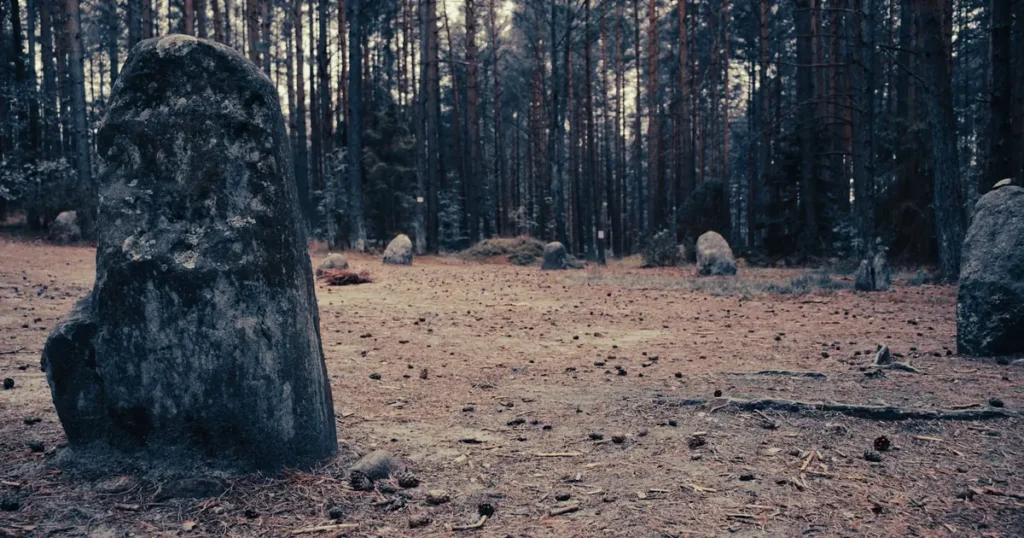
A blót ritual was a sacrificial feast: an animal was killed, its blood was collected and sprinkled on the altar, the walls and the people, and then everyone — gods included — ate the meat together and drank consecrated ale. That is the core of what we can actually say about Norse rituals. Most of what circulates online about Viking ceremony is nineteenth-century romanticism or outright invention; the honest picture is narrower, stranger and considerably more interesting. This article separates what the sources say from what people wish they said, and ends with a modern sumbel you can hold in your kitchen tonight without pretending to believe anything you don’t.
What a Blót Actually Was: A Sacrificial Feast, Not a Horror Scene
Ask what is a blót in Norse religion and the popular answer involves hooded figures and a lot of blood. The source material describes something closer to a village barbecue with a liturgy attached. The most detailed account we have — chapter 14 of Hákonar saga góða in Snorri Sturluson’s Heimskringla, written around 1230 — describes farmers travelling to the temple with food and, crucially, their own ale. Everyone drinks. Horses and cattle and smaller livestock are killed. The meat is boiled in cauldrons over fires down the middle of the hall floor. The cups pass around the fire and the man hosting the feast blesses them.
Two things follow from this. First, the blót was a communal meal, not a private devotion — it happened in a chieftain’s hall or at an open-air site, with the whole district present, and it had an economic dimension. Killing livestock before winter was something you had to do anyway. Doing it as a ritual meant the district ate well together at exactly the point in the year when meat had to be preserved or consumed. Second, there was no membership requirement or personal conversion. You attended because you lived there.
The Old Norse word for the feast itself is veizla, a hosting; blót refers to the offering. The two are inseparable in practice. When Snorri wants to say a king refused to participate in Viking ceremonies, the accusation is always social: he would not eat the horse meat, he would not drink the toasts, he made the sign of the cross over his cup. Refusal was a political act against the community, not a theological disagreement.
The Word Itself: Blóta, ‘To Sacrifice, To Worship, To Strengthen’
The verb blóta covers a wider range than English “sacrifice”. It means to worship, to honour with an offering, and to strengthen — the same root family as English blessing and, more distantly, blood. Gothic preserves a cognate, blotan, “to worship”. The semantic centre is not slaughter but strengthening a relationship through a gift.
This matters for reading the sources. When a saga says someone “blótaði Þór”, it does not necessarily mean an animal died. It can mean an offering of food, drink, metal or cloth. Archaeologists at wetland deposit sites across Scandinavia and Denmark have recovered weapons, tools, jewellery, agricultural implements and food remains — deliberately deposited, often deliberately broken first, so the object could not be recovered and reused. Deliberate destruction is a common marker of a gift that has genuinely left human circulation.
The reciprocal logic runs right through Hávamál, the gnomic poem in the Poetic Edda. Its most quoted stanzas are about gifts and obligation: a gift always looks for a return. The relationship with the gods worked on the same ledger as the relationship with a neighbour or a chieftain. You gave, and you expected — not guaranteed, but expected — good harvests, fair winds, victory.
The Hlaut: What the Blood Was For
Here is the mechanic almost every competing article skips. According to Snorri, the blood of the sacrificed animals was called hlaut and was collected in vessels called hlautbollar (hlaut-bowls). A twig or bundle of twigs called a hlautteinn — literally “hlaut-twig” — was used like an aspergillum to sprinkle that blood in three directions:
- Onto the stalli, the altar or pedestal where images of the gods stood.
- Onto the walls of the temple, inside and out.
- Onto the assembled people themselves.
The word hlaut is linguistically interesting: it appears related to hlutr, “lot, share, portion”, and to the verb hljóta, “to obtain by lot”. Some scholars read this as evidence that blood was originally used in divination — casting lots to read the outcome — and that the sprinkling function is a later or parallel development. We cannot settle it. What we can say is that the blood was not disposed of as waste. It was the medium that carried the sacrifice’s effect onto physical things and living bodies: building, image, congregation.
Note the direction of travel. The blood does not go up to the gods; it comes back down onto the people. The sacrifice is not a payment sent away. It is a substance that circulates through everyone present and marks them as included. If you want one detail that distinguishes real Norse paganism rituals from the invented kind, this is it — the sprinkling is inclusive and public, not secretive.
One honest caveat: Snorri is our only detailed witness for the hlautteinn, and he was a Christian writing two centuries after conversion, in a literary culture that knew perfectly well what a priest sprinkling holy water looked like. Archaeology cannot confirm a twig. It can confirm the animals — and it does, abundantly.
Sharing the Meal With the Gods: Why the Feast Was the Point
After the sprinkling came the cooking, and this is where the ritual’s real weight sits. The meat was boiled — not roasted — in large cauldrons, and everyone in the hall ate it. The gods were understood to be present at the meal and to receive their portion. This is not an offering burned up and sent elsewhere. It is commensality: eating with, rather than giving to.
Snorri lists a specific toasting order at the seasonal feast. Óðinn’s cup first, for victory and the king’s power. Then Njörðr’s cup and Freyr’s cup, for good harvests and peace — til árs ok friðar, a phrase that recurs across Old Norse literature and is probably a genuine liturgical formula. Some drank a bragarfull after that, and many drank cups in memory of dead kinsmen, called minni (memory-cups).
The archaeology backs the feasting picture strongly. At Tissø in Denmark — a major elite site occupied roughly from the seventh to the eleventh century — excavation revealed a magnate’s residence with an adjacent fenced enclosure containing a small building, interpreted as a cult structure, plus enormous quantities of animal bone and feasting debris. Similar patterns turn up at Lejre, at Uppåkra in Sweden (where a small, repeatedly rebuilt high-status building yielded a glass bowl and a bronze beaker deposited as offerings), and at Hofstaðir in Iceland, where the skulls of at least 23 cattle were found around a hall, many showing a single massive blow to the forehead and evidence of decapitation. The Hofstaðir skulls appear to have been displayed outdoors, weathering over years — a repeated, visible, annual act.
So: what animals did Vikings sacrifice? The bone assemblages say cattle, horses, pigs, sheep and goats, plus dogs and birds of prey in some contexts. Horse is the ritually loaded one. Horse meat consumption became the litmus test of paganism during the conversion period, and the Icelandic law that legalised Christianity in the year 1000 reportedly allowed the eating of horse flesh to continue as a concession — which tells you how deeply it was embedded.
Sumbel: The Ritual Toasts, and How It Differed From Blót
The difference between blót and sumbel is the single most useful distinction in this whole subject, and most pages get it muddled.
A blót is an offering: something is given — an animal, an object, food — and the transaction runs between humans and gods. A sumbel ritual (Old Norse sumbl, Old English symbel) is a formal drinking ceremony in which the transaction runs primarily between the humans present. Words are the substance being offered. The two often happened at the same gathering — feast, then drinking — but they are structurally different acts.
Sumbel appears across the Germanic world, not just in Scandinavia. Beowulf describes the same institution in an Old English hall: seating by rank, a woman of the household carrying the cup to each man in order, formal speech, and boasting that carries obligation. In Lokasenna in the Poetic Edda, the entire poem is a sumbel gone catastrophically wrong — Loki arrives at Ægir’s hall, invokes his guest-right, and then insults every god present in turn, which only works as a scene because the audience understood the rules he was breaking.
The mechanics we can reconstruct:
- Seating was by rank, and the order in which the horn reached you was itself a public statement about your standing.
- The cup was carried, usually by the lady of the hall or her daughters. In Beowulf, Wealhtheow’s circuit of the hall is a political act, not hospitality.
- What you said while holding the horn was binding. This is the crucial part. A boast (heitstrenging) made over the cup, in front of witnesses, was a commitment the community would hold you to.
- Nobody left mid-round. The ceremony had a shape and you sat through it.
Jómsvíkinga saga gives the classic example: at a funeral feast, the Jomsvikings are deliberately kept drinking and then invited to make boasts. Sigvaldi swears he will drive Earl Hákon out of Norway or die trying. His companions escalate in turn. They wake up sober, remember what they said, and go — because the oaths were spoken aloud in a hall full of witnesses, and taking them back was not socially available. The sumbel’s power is not magical. It is the binding force of a public statement.
The Three Rounds: Gods, Ancestors, and Boasts or Oaths
The familiar three-round structure — gods, then ancestors, then boasts — is a modern reconstruction, and you should know that before you use it. No single medieval source lays out three rounds in that order as a fixed template.
What the sources do give us are the ingredients. Snorri’s toasting sequence (Óðinn, then Njörðr and Freyr) is a round to the gods. The minni, the memorial cups drunk to dead kinsmen, is a round to the ancestors — and in Ynglinga saga Snorri says the cup to a dead king was drunk at his funeral ale before the heir took his father’s seat, which makes it a formal transfer of authority. The bragarfull (“chieftain’s cup” or possibly “cup of Bragi”) is the vow cup, over which a successor swore what he would accomplish.
So the three rounds are a reasonable synthesis of genuine elements arranged into a shape no source explicitly prescribes. That’s a legitimate thing for a modern practice to do — as long as it’s labelled honestly rather than presented as an unbroken thousand-year-old script.
Who Ran the Ritual? The Goði, the Chieftain’s Hall, and the Sacred Landscape
If you want to know who led Viking blót rituals, the answer is not “a priest” in any sense a modern reader would recognise. There was no clergy, no seminary, no ordination and no religious institution separate from ordinary power.
The goði Norse priest (plural goðar; feminine gyðja) was a chieftain who happened to hold ritual responsibility as one function of secular authority. The word derives from goð, “god”. In Iceland the role became formalised in a way it never quite did elsewhere: after the settlement, the island was organised around a set of goðorðs, chieftaincies that were property — they could be inherited, shared, bought and sold. Free farmers chose which goði to align with and could switch. A goði represented his followers at the Alþingi, arbitrated disputes, and hosted the local blót. When Iceland converted around the year 1000, many goðar simply continued as the same men in the same halls, and a number of them became Christian priests. The office survived the theology.
Beyond the goði there were other ritual specialists: the þulr (a speaker or reciter of lore, possibly a memory-keeper), and the völva, the seeress, who operated on a different circuit entirely — travelling rather than landed, feared rather than elected. We’ll come to her.
Hof, Hörgr and Grove: Where Ceremonies Happened
Two Old Norse words dominate. A hof was a hall — probably in most cases a chieftain’s ordinary feasting hall used for ritual at certain times, rather than a dedicated temple standing empty the rest of the year. A hörgr was something outdoors: a stone altar, a cairn, or a heap of stones. Hávamál and Hyndluljóð both mention a hörgr built of stones and reddened with sacrificial blood. Sacred groves and individual trees appear too, and place-names across Scandinavia preserve the pattern — Danish and Swedish names built on -lund (grove), -vé (sanctuary) and -hov mark hundreds of former ritual sites.
The grand stave-built pagan temple of popular imagination is largely a nineteenth-century picture. Excavation keeps finding the same thing instead: a big hall, and sometimes a small separate structure nearby. Ritual space in the Viking Age was mostly ordinary space used in a marked way at marked times — which, if you are wondering whether your kitchen table counts, is quite encouraging.
Seiðr: The Other Norse Ritual Practice, and Who Was Allowed to Do It
Blót and sumbel were public and communal. Seiðr was neither. Asking what is seiðr and who practised it takes you into the most gendered and most socially fraught corner of Norse religion.
Seiðr was a form of magic involving trance, spirit contact and prophecy, along with less respectable applications — influencing minds, causing illness, affecting weather and luck, sometimes killing. Ynglinga saga says Freyja taught it to the Æsir and that Óðinn was its greatest master. The same passage adds a critical line: the practice was accompanied by such ergi — unmanliness, sexual shame — that it was thought disgraceful for men, and so it was mostly taught to and practised by women.
That accusation had teeth. Ergi was one of the gravest insults in Old Norse society; the law codes made certain slurs of that kind grounds for outlawry or lethal retaliation. Yet Óðinn, the highest god, practises seiðr — and Loki throws it in his face in Lokasenna. The contradiction is real and unresolved, and it is one of the more revealing things in the corpus: the culture’s chief god did the thing the culture said no man should do.
The fullest description is in Eiríks saga rauða, chapter 4, set in Greenland. A seeress called Þorbjörg, “the little völva”, travels between farms during a famine. Her arrival is described in unusual detail: a blue or black cloak set with stones, a staff with a brass-mounted knob, a hood of black lambskin lined with white catskin, catskin gloves with white fur inside, calfskin shoes, and a pouch of charms at her belt. She is seated on a raised platform (seiðhjallr), fed a meal of the hearts of every kind of animal available on the farm, and requires a woman who knows the varðlokkur — the warding songs — to sing so the spirits will come. Only one woman present knows them: Guðríðr, a Christian, who agrees reluctantly. The spirits come, and Þorbjörg delivers her prophecy.
Archaeology gives this an unexpected physical footing. More than forty Viking Age graves across Scandinavia and the British Isles contain iron or bronze staffs of a distinctive type, and the great majority are women’s burials, often unusually rich. The best known is the Fyrkat grave 4 in Denmark, which held a woman with a metal staff, a bronze bowl, a box containing henbane seeds — a genuinely psychoactive plant — and objects from far outside Scandinavia. Whatever the sagas got wrong, they did not invent the staff-carrying woman.
The Wheel of the Year: The Major Seasonal Blóts
Snorri names three annual sacrifices in Ynglinga saga: one at the start of winter for a good year, one at midwinter for growth, and one in summer for victory. Elsewhere he mentions others. The pattern is real. The precise dates, deities and correspondences you find in most online guides to seasonal blót festivals in the Norse calendar are considerably firmer on those sites than they are in the evidence.
The Old Norse year had two seasons, not four: summer and winter. Reckoning was lunisolar and varied regionally, which is exactly why anchoring a blót to a fixed modern date is a modern convenience rather than a recovered fact. Anyone interested in how seasonal and lunar patterns in spiritual practice get standardised over time will recognise the process: a flexible reckoning gets pinned to a calendar because a calendar is easier to organise around.
Vetrnætr, Jól and Sigrblót — and Why the Dates Are Fuzzier Than Most Sites Admit
| Festival | Approximate modern timing | Associated beings | What the source actually says | Source | Confidence |
|---|---|---|---|---|---|
| Vetrnætr (Winter Nights) | Mid–late October | Dísir; freyr in some readings | Sacrifice at the beginning of winter “for a good year”; the dísablót and álfablót are associated with this period | Ynglinga saga; Austrfararvísur (Sigvatr Þórðarson) | Well attested as a season; specific date modern |
| Jól (Yule) | Midwinter, roughly late December–January | Óðinn; ancestors; the dead generally | Midwinter sacrifice “for the growth of crops”; Hákon the Good legislated Yule to coincide with Christmas | Ynglinga saga; Hákonar saga góða | Well attested; original date shifted by law |
| Dísablót | Autumn (Norway/Iceland) or February (Sweden) | The dísir, female ancestral or protective spirits | Held at the Dísaþing assembly at Uppsala in one account; a domestic autumn observance in another | Ynglinga saga; Hervarar saga; Víga-Glúms saga | Attested but regionally inconsistent |
| Sigrblót | Around the start of summer, roughly April | Óðinn | “Summer sacrifice for victory”; connected with the start of raiding and travel season | Ynglinga saga | Attested, thinly; details reconstructed |
| Midsummer observance | Late June | Varies by modern tradition | No Viking Age Scandinavian source describes a midsummer blót; midsummer festivity is well documented from later folk practice | — | Mostly modern |
The one enormous outlier is the festival Adam of Bremen describes at Uppsala: held every nine years, lasting nine days, with nine males of every species sacrificed and their bodies hung in a grove. That is not a seasonal blót. It is a claimed once-in-a-decade event described by a man who never went there — and it deserves its own scrutiny, below.
How Do We Even Know This? The Sources — and Their Serious Problems
Here is the part most articles on Norse rituals leave out, and it changes how you should read everything above. There is no surviving text written by a practising Norse pagan describing their own religion. Not one. Every written source is either Christian, foreign, centuries late, or all three.
What we have divides into four categories, each with a characteristic failure mode:
- Icelandic sagas and Snorri’s works — rich in detail, written 200–300 years after conversion by Christians.
- Eddic and skaldic poetry — potentially older, orally transmitted, but preserved in thirteenth-century Christian manuscripts and often obscure.
- Foreign observers — Adam of Bremen, Ibn Fadlan, various Frankish chroniclers — writing about people they regarded as enemies, heathens or curiosities.
- Archaeology — the only category not filtered through a hostile or distant narrator, and the only one that cannot tell you what anyone believed.
Snorri Sturluson: A Christian Historian Writing About Pagan Ancestors
Snorri Sturluson (1179–1241) was an Icelandic chieftain, lawspeaker, poet and politician. He wrote the Prose Edda around 1220 and Heimskringla around 1230. He is our single most important source for Norse mythology and ritual, and he was born roughly 180 years after Iceland’s official conversion.
He was also not writing anthropology. The Prose Edda is explicitly a handbook for poets — its purpose is to preserve the mythological vocabulary that skaldic verse depends on, so that young poets could still understand what a kenning meant. Its prologue does something remarkable: it rationalises the Norse gods as human kings from Troy who were later mistaken for gods. That is a Christian intellectual strategy (euhemerism) for handling ancestral paganism without endorsing it, and it tells you exactly what frame Snorri was working in.
None of this makes him worthless. He had access to poetry we no longer have, he quotes his sources, and he shows genuine care for tradition. But when he describes the hlautteinn sprinkling blood on walls and people, we are reading a thirteenth-century Christian’s reconstruction of what his great-great-grandparents did — written by a man who attended Mass and had watched a priest do something structurally similar every Sunday of his life.
Adam of Bremen and the Temple at Uppsala: A Hostile Witness at Second Hand
Adam of Bremen wrote his Gesta Hammaburgensis Ecclesiae Pontificum around 1073–1076. His account of the temple at Uppsala is the most cited passage in the entire literature of Norse religion. It is also, source-critically, close to a worst case.
Adam describes a temple entirely covered in gold, three statues — Thor in the centre with Wodan and Fricco flanking him — a sacred evergreen tree beside it, a well for drowning sacrifices, and a nine-yearly festival at which nine males of every living creature, including men, were hanged in an adjacent grove until the bodies rotted. He states that a Christian informant told him he had seen seventy-two bodies hanging there.
The problems:
- He never went to Sweden. He was writing in Bremen from informants, chiefly the Danish king Sveinn Estriðsson.
- He was writing institutional propaganda. The Gesta exists to argue for the Archbishopric of Hamburg-Bremen’s authority over the northern mission field. A vividly appalling pagan Sweden strengthens that case.
- The numbers are suspiciously literary. Nine years, nine days, nine of each species, seventy-two bodies. Nine is the standard sacred number of Norse tradition; it is also exactly what a learned writer would supply if he were filling gaps.
- The most lurid material sits in a scholion — a marginal note added to the manuscript, possibly by Adam and possibly later.
- Excavation under Gamla Uppsala church has not produced the golden temple. What it has produced is evidence of large halls, enormous burial mounds and a genuinely major cult centre — so the site’s significance is real even where Adam’s description isn’t.
The honest position: Uppsala was a major religious centre. Something significant happened there. Adam’s specific details should be treated as a hostile foreign account at second hand, structured by numerology and written to justify a missionary programme.
What the Archaeology Adds — and What It Can’t Tell Us
Archaeology is the corrective. It is not filtered through anyone’s theology, and it repeatedly confirms the outline of the written picture while flattening the drama.
What it confirms: large-scale animal slaughter and feasting at elite halls (Tissø, Lejre, Uppåkra, Hofstaðir); deliberate deposition of valuable objects in wetlands; small cult buildings adjacent to magnate residences; staffs in women’s graves; a handful of sites with human remains in contexts that are difficult to explain any other way.
What it cannot do: tell you what anyone said, believed, intended or felt. A cattle skull with a poleaxe wound tells you an animal died in a particular way at a particular place. It cannot tell you whether the people present were praying, or which god they named, or whether they meant it. That gap is permanent, and anyone who tells you otherwise is selling something.
Did the Vikings Practise Human Sacrifice? An Honest Answer
Probably yes, rarely, and almost certainly not in the way popular culture depicts it. That is the most defensible answer to did the Vikings practise human sacrifice, and it deserves unpacking rather than a headline.
The evidence in favour:
- Multiple independent written traditions mention it — Adam of Bremen at Uppsala, Ibn Fadlan’s tenth-century eyewitness account of a Rus’ ship funeral on the Volga in which an enslaved girl was killed to accompany her dead master, and scattered saga references to kings sacrificed in times of famine.
- Archaeological double burials where one individual was clearly killed — decapitated, bound, or placed in a subordinate position — appear at a number of sites, including Ballateare on the Isle of Man and Birka in Sweden. Isotope analysis at several Danish sites indicates the secondary individuals often had different, poorer diets, consistent with enslaved status.
- Bog bodies from the wider region show deliberate killing and deposition — though most of the famous examples predate the Viking Age by several centuries.
The qualifications, which matter just as much:
- Every written source is Christian or Muslim, describing a religion its author considered false. “They kill people” is the oldest accusation in the book, levelled at Christians by Romans before it was levelled at pagans by Christians.
- The archaeological cases number in the dozens across three centuries and a vast geography. This was rare, exceptional and probably crisis-driven, not a routine seasonal event.
- The victims, where identifiable, were overwhelmingly enslaved people or prisoners of war — which locates the practice in the brutality of a slave-owning warrior society rather than in a distinct appetite for ritual killing. Slavery was the enabling condition.
The picture, then: a society that killed people in ritual contexts occasionally, at moments of extreme importance — a great man’s funeral, a famine, a major festival — using people it already regarded as property. That is grim enough without embellishment, and it is not a reason to avoid the subject. It is a reason to describe it accurately.
Modern Ásatrú and Heathenry Is Not the Same Thing
Modern Ásatrú, Heathenry, Forn Siðr and Norse paganism are living twentieth- and twenty-first-century religions. They are sincere, they are legally recognised in several countries, and they are reconstructions, not survivals. The chain of transmission broke roughly a thousand years ago.
Ásatrúarfélagið, the Icelandic Ásatrú Fellowship, was founded in 1972 and received official recognition as a religious body in 1973. Comparable organisations exist across Scandinavia, the UK, North America and elsewhere. Practitioners hold blóts — typically with mead, cider, bread or symbolic offerings rather than animal slaughter — and sumbels, and many are candid that they are building something new from fragmentary material rather than continuing an unbroken line.
That candour is the healthy version. The unhealthy version claims a direct lineage, an initiatory secret, or a “true” reconstructed ritual passed down in a family. Given that no practising pagan left a written account of their own liturgy, any such claim is unverifiable at best. Treating Norse practice as one strand among many ways of incorporating ritual into daily spiritual practice — rather than as a recovered ancestral birthright — is both more honest and, in practice, more useful.
A Word on Norse Symbols and Extremist Misuse
Some Norse symbols have been appropriated by white supremacist and neo-Nazi groups: the Othala and Tiwaz runes, the valknut, Mjölnir in certain stylings, and the term “Odinism” in some usages. The Anti-Defamation League’s hate symbols database lists several of these with the explicit note that they are used far more often in benign contexts than hateful ones. Wearing a Thor’s hammer does not make anyone a racist.
What it does mean is that the symbols carry contested meaning in public, and that inclusive Heathen organisations have spent decades saying so loudly — Declaration 127, signed by more than 180 Heathen groups internationally, is a formal public repudiation of racist Heathenry. Knowing this context is simply part of engaging with the material responsibly.
How to Hold a Respectful Modern Sumbel at Home
A sumbel is the most transferable piece of Norse ritual practice, for one reason: its mechanism is entirely social. It works by having you say something out loud, in a specific order, in front of people who will remember. No belief is required for that to function.
What You Need (Five Things You Probably Already Own)
- A drink to share. Mead is traditional; cider, beer, apple juice or tea all work. One shared vessel matters more than what’s in it.
- One cup or horn passed hand to hand. The sharing is the ritual. Individual glasses break it.
- A table and chairs, with everyone seated and facing in. No standing, no phones, no music.
- Two or more people. Three to eight is ideal. A sumbel alone is not a sumbel — you need witnesses.
- Paper and a pen for the third round. This one is not historical. It is the single most useful addition.
A candle and a cleared surface help set the space apart, and the same principles that apply to creating a sacred space for ritual practice apply here — a marked, deliberate surface signals to everyone present that ordinary conversation has paused.
The Three Rounds, Step by Step (With What to Actually Say)
- Open it. The host fills the cup and says plainly what is happening: that there will be three rounds, that the cup passes in one direction, that when you hold it you speak and everyone else listens without interrupting, and that when you have finished you drink and pass it on. Say out loud that this is a modern practice drawn from Norse sources, not a reenactment.
- Round one — the gods, or what stands in for them. Traditionally Óðinn, Þórr, Freyr, Freyja. If you don’t believe in them, don’t perform belief. Honour something real instead: the season, the harvest, the land you live on, the year that’s ending.
- Round two — the ancestors. Each person names one specific dead person and says one true thing about them. Not “my ancestors” — a name.
- Round three — the oath. Each person states one concrete thing they will do before a stated date. Specific, verifiable, achievable. Then write it down.
- Close it. The host says the sumbel is ended. The written oaths go somewhere visible. Then the evening becomes an ordinary evening again — the boundary is part of the structure.
A Worked Example: Thursday Night, Four Friends, One Bottle of Cider
It’s a Thursday in late October — roughly Vetrnætr, as it happens, though nobody planned it that way. You have four friends, one bottle of dry cider, and no drinking horn. You have a chipped ceramic mug your grandmother gave you, which is better.
You clear the kitchen table. Phones in a bowl by the door. One candle. Everyone sits. You pour the cider into the mug — a third full, no more, because it’s going round three times and four people are drinking — and you say:
“Three rounds. First to something bigger than us, second to our dead, third to a promise. When you’re holding the mug you talk and we listen. Then you drink and pass it left. This isn’t a reenactment — it’s a modern thing built out of old Norse ritual. Deal?”
Round one. Nobody at the table believes in Thor, so nobody pretends to. You hold the mug and say: “To the harvest. There are apples in this cider that grew forty miles from here and somebody picked them. To the people who did that.” You drink, pass left. Your friend says: “To the dark coming. I’ve been dreading it since August and I’d rather greet it than get ambushed by it.” The third says: “To this table. Four of us, still here, ten years on.” The fourth: “To the river I walk along every morning. It doesn’t care about me and I find that restful.” Four honest statements. Nobody has said anything they don’t mean.
Round two. One named person each. You go first: “To my grandmother Eileen, who kept every letter anyone ever sent her in a biscuit tin, and I have the tin.” Drink, pass. “To my father’s brother Michael, who taught me to drive and shouted the whole time.” “To my grandmother Wanda, who came here in 1968 with one suitcase and never once said it was hard.” “To my friend Sam, three years this January.” The room changes at this point. It always does. Names do something that categories don’t.
Round three. One concrete promise each, with a deadline, and it gets written down. Not “I’ll be healthier.” You say: “By the last day of November, I will have scanned every letter in Eileen’s tin and sent the file to my mother and my cousin.” You write it on the paper and read it back. Your friend: “By the 15th of November I’ll have booked the doctor’s appointment I’ve been putting off since June.” The third: “I’ll call my sister this Sunday. Not text. Call.” The fourth: “By the end of the month I’ll have finished the first draft, even if it’s bad.”
Four sentences on one sheet of paper, dated, with four names beside them. You stick it on the fridge. You say: “That’s the sumbel. Who wants pasta?”
Here is why this works, and it has nothing to do with the supernatural. A promise made silently to yourself has one witness and no cost to abandon. The same promise, spoken aloud, in a defined moment, in front of three people who will see you next month and remember — that is a different object entirely. Add a written record on the fridge and you have built a small, cheap accountability structure out of a thousand-year-old social technology. The Jomsvikings sailed to Norway on the strength of it. Your friend will book the appointment.
Honest Caveats: What This Is and Isn’t
This is a modern practice built from historical fragments. The three-round structure is reconstructed. Your kitchen is not a chieftain’s hall, and cider in a mug is not consecrated ale passed by the lady of the house at Lejre.
What it is: a genuinely old idea about how public speech binds people, used honestly. If you want to go further, read the sources themselves — Hávamál, Hákonar saga góða, Eiríks saga rauða — rather than another summary. And if a group you encounter claims unbroken lineage or gatekeeps by ancestry, those are both signals worth taking seriously.
Co udělat teď
- Read chapter 14 of Hákonar saga góða this week. It’s about two pages, freely available in English translation online, and it is the single source behind ninety percent of what you’ll read about blót anywhere.
- Pick a date for a sumbel within the next three weeks and invite three to seven people by name. An open invitation produces no sumbel.
- Choose your one shared vessel before the night — a mug with a history beats a bought horn.
- Write your round-three oath before your guests arrive, with a specific deadline inside 30 days, so you’re not improvising under pressure.
- Put the written oaths somewhere you’ll see daily — fridge, bathroom mirror — and set a calendar reminder for the deadline date.
- Before joining any Heathen group, check whether it has signed Declaration 127 or states an inclusive position publicly. Ask directly if it isn’t stated.
- Diarise a follow-up gathering for the day after the last deadline — the accountability only completes if the group reconvenes.
Často kladené otázky
What is a blót in Norse religion?
A blót was a sacrificial feast in which animals were killed, their blood (hlaut) was sprinkled on the altar, the walls and the participants with a twig, and the meat was then cooked and eaten communally with the gods understood to share the meal. The word blóta means to sacrifice, worship or strengthen.
What is the difference between a blót and a sumbel?
A blót is an offering — food, an animal or objects given to the gods. A sumbel is a formal drinking ceremony in which words are the offering: toasts, memorials and binding oaths spoken over a shared cup in front of witnesses. They often took place at the same gathering but are structurally different acts.
Did the Vikings really practise human sacrifice?
Probably, but rarely and in exceptional circumstances such as elite funerals, famine or major festivals. Archaeological double burials and accounts by Adam of Bremen and Ibn Fadlan support it, but every written source is Christian or Muslim and hostile, and the victims were overwhelmingly enslaved people rather than volunteers.
What animals did the Vikings sacrifice at a blót?
Cattle, horses, pigs, sheep and goats were the main sacrificial animals, with dogs and birds of prey appearing in some burial contexts. Horses were the most ritually significant, and eating horse meat became the defining marker of paganism during the conversion period.
Who led the rituals in Viking society?
The goði — a chieftain who held ritual authority as one part of secular power — led blóts, with the feminine form gyðja for women in the role. There was no separate priesthood; in Iceland a goðorð (chieftaincy) was property that could be inherited, bought or sold.
How often were blóts held, and when?
Snorri names three annual sacrifices: at the start of winter (Vetrnætr, mid-to-late October), at midwinter (Jól), and at the start of summer (Sigrblót, roughly April). The Old Norse year had two seasons and lunisolar reckoning, so exact modern dates are conveniences rather than recovered facts.
What was seiðr, and who was allowed to practise it?
Seiðr was a form of trance-based magic used for prophecy, spirit contact and influencing people or events, practised mainly by women such as the völva. Sources say it carried ergi — sexual shame — for men who performed it, though Óðinn himself is described as its greatest master.
Is modern Ásatrú the same as the Norse religion the Vikings practised?
No. Modern Ásatrú and Heathenry are twentieth-century reconstructions built from fragmentary sources, with Ásatrúarfélagið founded in Iceland in 1972. The chain of transmission from Viking Age practice broke around a thousand years ago, and no practising Norse pagan ever wrote down their own liturgy.