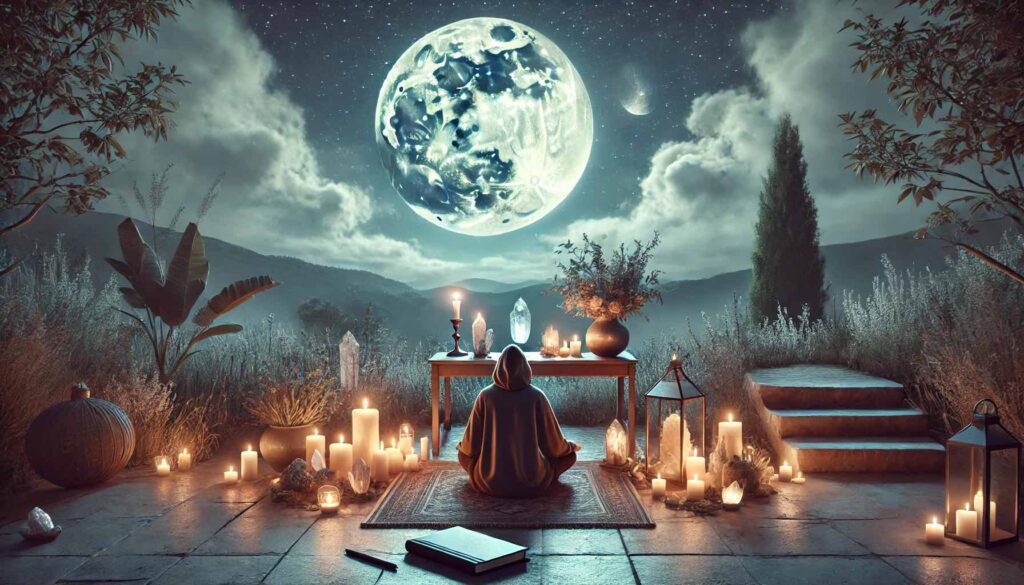
Moon rituals are simple, personal ceremonies tied to the phases of the Moon — most often the new moon and the full moon — where you set an intention or release something that no longer serves you. You don’t need crystals, an altar, or any special skill: a candle, a notebook, and ten quiet minutes are enough. Below you’ll find what moon rituals actually involve, how a new moon ceremony differs from a full moon one, and how to run your very first ritual tonight.
If you’ve heard the phrase lunar rituals tossed around wellness and manifestation spaces but never got a plain explanation, this guide starts from zero. It covers the definition, why each phase matters, a concrete step-by-step routine, and a full walkthrough of one beginner’s first month working with the Moon.
What Are Moon Rituals?
A moon ritual is a short, deliberate ceremony you align with the current phase of the Moon to create space for reflection, intention-setting, or letting something go. The word “ritual” here doesn’t imply anything occult or religiously binding. It’s a structured pocket of attention — the same way some people brew coffee in the same mug each morning and read a few pages before the day starts. The difference with lunar rituals is that the structure comes from a natural cycle lasting roughly 29.5 days, repeating for as long as you’re alive to notice it.
At its core, this is about deliberate mindset setting. When you know tonight is a new moon, you ask yourself: “What do I want to create over the next few weeks?” When it’s a full moon, the question flips: “What’s holding me back, and what am I ready to release?” The Moon works like a recurring alarm clock that reminds you to pause. That’s why people talk about “moon magic” — not spellcasting, but a small, repeated ritual that gradually reshapes how you think about your goals and emotions.
So what is a moon ritual, concretely, and what isn’t it? A quick breakdown helps:
- It is a dedicated window for reflection tied to a specific moon phase.
- It is a tool for setting and tracking personal intentions — career, relationships, health, or creative goals.
- It is a form of simple self-care that anyone can do with zero prior experience.
- It is not a religion, a sect, or anything that conflicts with your worldview — atheists and believers alike can take the practical part and leave the rest.
- It is not a guarantee of outcomes. The Moon doesn’t “make” anything happen; it’s a framework that organizes your own attention and follow-through.
That low barrier to entry is exactly what makes moon rituals for beginners so approachable. You don’t need to believe in astrology to appreciate that a recurring cycle, twice a month, nudges you to sit down, write a few sentences, and check in on where you’re headed.
Why Do People Do Moon Rituals?
People turn to lunar rituals for very practical reasons, even though the practice itself sounds spiritual on the surface. The most common motivation is the need for a regular pause in a year that otherwise blurs into one long stretch. Moon phases offer a visible, built-in calendar — you can just look up — and that calendar invites reflection twice a month without you having to remember to schedule it.
The main reasons people stick with moon rituals include:
- Regularity without pressure. New Year’s resolutions happen once a year, and by February most are forgotten. A lunar cycle gives you a “small new year” every four weeks, so there’s always another chance to adjust or renew an intention.
- Emotional release. A full moon release ritual is a safe way to name frustration, resentment, or fear and symbolically let it go — for example, by writing it down and tearing up the paper.
- Clarity around goals. Writing down new moon intentions forces vague wishes into concrete sentences. “I want to be happier” becomes “I want to carve out an hour just for myself three times a week.”
- A sense of connection to nature. At a time when most people spend their days staring at screens, tracking a real natural cycle offers a grounding counterweight.
- Ritual as self-care. A lit candle, silence, and ten minutes alone already carry a calming effect similar to meditation or journaling.
It’s worth being straightforward that moon rituals have no proven “magical” effect on external reality. Their value is psychological and organizational: they help you focus your attention, name your priorities, and return to them on a schedule. For anyone looking for structure and calm, that’s usually exactly what they get out of the practice.
The Moon Phases and What Each One Means
Timing a ritual well means understanding how the lunar cycle works. The Moon orbits Earth roughly once every 29.5 days, and as it does, the portion lit by the Sun keeps changing. That produces eight recognizable phases that repeat endlessly. For ritual purposes you don’t need to memorize all eight — just the four main milestones and the energy they traditionally represent.
Moon phases and their meanings are usually described this way in ritual practice: the new moon is beginnings and planting seeds, the waxing moon is growth and building, the full moon is peak and harvest, and the waning moon is release and rest. It’s essentially the metaphor of a farming year compressed into a single month.
New Moon, Waxing, Full Moon and Waning at a Glance
- New moon: The Moon is essentially invisible in the sky. It represents a fresh start, a blank page, and the planting of intentions. This is the ideal time for a new moon ritual, planning, and deciding what to pursue next.
- Waxing crescent and first quarter: The lit portion grows. This is “building” energy — time to take action, form small habits, and move step by step toward the intention you set at the new moon.
- Full moon: The Moon is fully lit and at its brightest. It represents peak, fullness, and reckoning. This is the strongest moment for a full moon ritual — celebrating what worked and releasing what’s in the way.
- Waning gibbous and beyond: The light fades. A period of slowing down, resting, tidying up, and forgiving, which flows naturally back into the next new moon.
In practice, most beginners only need to track two key points in the cycle — the new moon and the full moon. Roughly 14 to 15 days pass between them, giving you a natural rhythm of “set an intention, then two weeks later check in and release what’s not working.” Exact dates for the new and full moon are easy to find in any calendar, moon-phase app, or by simply looking up at the sky.
New Moon vs Full Moon Rituals: What’s the Difference?
The main distinction is simple: the new moon is about attraction and setting intentions, the full moon is about release and letting go. A new moon ritual is like planting a seed — you look forward and name what you want to create. A full moon ritual is like harvesting the crop and pulling the weeds at the same time — you look back, celebrate progress, and deliberately release whatever is draining your energy. That’s the whole core of the new moon vs full moon ritual comparison.
To make the difference between setting intentions and releasing clear at a glance, a table helps:
| Criteria | New Moon Ritual | Full Moon Ritual |
|---|---|---|
| Energy and theme | Fresh start, quiet beginning, “blank page” | Peak, fullness, bright light, culmination |
| Best for | Planning, dreaming, new projects and intentions | Reflecting, gratitude, and letting go of weight |
| Ritual focus | Setting an intention (what I want to attract) | Release (what I want to let go of) |
| Example action | Write 3 specific intentions for the coming cycle | Write down what you’re releasing, then tear up the paper |
| Mood | Hope, focus, quiet resolve | Gratitude, relief, catharsis, calm |
In practice, the two rituals complement each other beautifully. At the new moon you set a direction, spend two weeks acting on it, and at the full moon you sit down, evaluate your progress, and set aside anything that got in the way — doubt, old resentment, a habit that’s slowing you down. If you specifically want to go deeper into the second half of the cycle, there’s a wide range of ideas and more advanced approaches for full moon rituals that go beyond a basic release exercise. For an absolute beginner, though, one sentence covers it: the new moon sets, the full moon releases.
How to Start a Moon Ritual: A Simple Step-by-Step for Beginners
The best news for anyone wondering how to start moon rituals is this: you don’t need to buy anything, and you don’t need any special skill. The routine below works for both the new moon and the full moon — only the third step changes. This whole approach falls into the broader category of ways to incorporate rituals into your spiritual practice using things you already have at home. Let’s walk through the five steps that make up the ritual.
Step 1: Create a Calm, Sacred Space
“Sacred” here doesn’t mean anything religious — it just means setting aside a spot where nothing will interrupt you. Turn off your phone, or at least switch it to do-not-disturb. Dim the main light, light a candle, and crack a window for fresh air if you can. A corner by the window, the edge of your bed, or the kitchen table after dinner all work just as well as an elaborate setup.
If you enjoy having a consistent spot for these moments, you can gradually work on creating a spiritual altar — a small shelf with a candle, a notebook, and a few objects that mean something to you. That’s not a requirement, though. For your first ritual, a flat surface, a candle, and quiet are all you need. The point of this step is simply to signal to your brain that it’s time to turn attention inward.
Step 2: Ground and Center Yourself
Before you write anything, spend a minute moving from the pace of your day into stillness. A few slow breaths do the job: inhale for a count of four, hold briefly, exhale for a count of six. Repeat that five or six times. Notice how you’re sitting, how your feet meet the ground, how you’re breathing. This short transition matters more than it looks — skip it, and the ritual easily turns into just another item you check off a list.
If you like, add a simple phrase you say silently, such as: “I am here, now. This moment is mine.” It’s not a spell — it’s a way of shifting your attention.
Step 3: Set an Intention (New Moon) or a Release List (Full Moon)
This is the heart of the whole ritual — the reason you carved out the time in the first place. The exact step depends on the moon phase.
At the new moon, if you want to know how to do a new moon ritual, write one to three specific intentions for the coming cycle in your notebook. The keyword is “specific.” Instead of “I want to be healthier,” write “I want to take a thirty-minute walk three times a week.” Good intentions share three traits:
- They’re stated positively — describing what you want, not what you want to avoid.
- They’re measurable or observable, so you can tell at the full moon how you did.
- They’re within your own control — about your actions, not other people’s.
This is exactly the skill behind setting intentions with the moon: the cycle gives you a built-in deadline for checking in, so the intention doesn’t just become another forgotten wish.
At the full moon, flip the perspective. Write a list of what you’re releasing — habits, thoughts, worries, old resentments, situations that drain you. Avoid vague statements; be specific and honest: “I’m releasing the feeling that I have to be available to everyone, all the time.” You’ll safely destroy this list later on, as part of the full moon release ceremony described in the walkthrough below.
Step 4: Reflect, Visualize or Journal
Once your intention or list is on paper, give it a moment of life. At the new moon, briefly picture what it will feel like once the intention is fulfilled — where you’ll be, how you’ll feel, what you’ll be doing differently. This kind of visualization turns an abstract sentence into a vivid, motivating image you can return to during an ordinary weekday.
At the full moon, reflection fits better: what went well over the past two weeks, what you’re grateful for, and why you actually want to let a given thing go. A few lunar cycle journaling prompts work well here — write them down and answer them:
- What gave me the most energy this cycle, and what drained it?
- Which intention from the new moon moved forward, and which stalled — why?
- What am I holding onto out of habit alone, even though it no longer serves me?
- What would I like to do differently next cycle?
Journaling isn’t mandatory, but it meaningfully raises the value of the whole practice — it captures a record you can look back on months later and read as a map of your own growth.
Step 5: Close with Gratitude
End the ritual with a short thank-you — to yourself, for taking the time, and, if it feels right, to the Moon or simply to life for what you have. One or two sentences, spoken aloud or silently, are enough. Then blow out the candle (safely — never leave it burning unattended), and you’re done.
This small closing step has a surprisingly large effect: it gives the ritual a clear endpoint and leaves you with a sense of calm rather than the feeling of an unfinished task. Gratitude also gently shifts your attention from what’s missing to what’s already working.
How Long Does a Moon Ritual Take?
The question of how long does a moon ritual take has a simple answer: usually 10 to 30 minutes. Your very first ritual can easily be done in ten minutes — a minute to ground yourself, a few minutes to write an intention or list, a short reflection, and a brief closing thank-you.
A longer version — journaling at length during the full moon, meditating, or taking a candlelit bath — can stretch to 45 to 60 minutes, but that’s entirely optional. Consistency matters more than length: a short, ten-minute ritual done at every new and full moon delivers more than a one-hour ceremony done once a year.
What Supplies Do You Need for a Moon Ritual?
The answer to what supplies do you need for a moon ritual is good news for any beginner: practically nothing extra. The basic kit you can start with tonight looks like this:
- A candle (any kind — a tea light or a plain table candle) as a symbol of focus and light.
- A notebook and pen for intentions, a release list, or journal entries.
- A quiet spot and a few minutes where nobody will interrupt you.
That’s the complete essential minimum. If you want to, you can gradually add optional extras that add atmosphere but aren’t required:
- Crystals — most often clear quartz or moonstone, which some people place near their written intentions as a reminder.
- Incense, palo santo, or sage for atmosphere (mind the smoke detector, and keep the room ventilated).
- Herbal tea, brewed and sipped slowly.
- A moon-phase calendar or app, so you know the exact dates of the new and full moon.
The important part is not to mistake the props for the ritual itself. Crystals or incense don’t make a ritual “more powerful” — your attention and honesty do. Supplies are the set dressing, not the engine.
Can You Do Moon Rituals Without Crystals or an Altar?
Yes, and this might actually be the easiest way to start. A moon ritual without crystals is completely valid — the entire essence of the practice sits in dedicated time, a clear intention, and honest reflection, not in objects on a shelf. Plenty of experienced practitioners stick with the simplest version — a candle and a notebook — for years, precisely because nothing distracts them.
Here’s why this “minimalist” path often works best for beginners:
- No barrier to entry. You don’t have to wait until you’ve bought something or set up an altar “correctly.” You can start tonight.
- Focus on the substance. Without props, your attention naturally goes to the one thing that actually matters — your intentions and feelings.
- Portability. A ritual with a candle and paper works at home, at a cabin, or in a hotel room. You’re not tied to a place.
- No pressure toward “perfection.” Without an altar, there’s no altar to get “wrong.”
If a candle isn’t available, or you can’t light one — a dorm room, say — swap it for a lamp, a candle app, or simply an open window with a view of the night sky. The ritual lives or dies on your presence, not your gear. You can always add an altar or crystals later, whenever you feel like it — or never, if the simple version suits you fine.
Your First Month: A Simple Lunar Ritual Walkthrough
To keep all of these phases and steps from staying purely theoretical, here’s one full lunar cycle through the eyes of a beginner. Call her Maya. She has no crystals, no altar, and has never done anything like this before. She has a candle, a small notebook, and about ten minutes each evening. Here’s how her month unfolds.
Day 0 — new moon, evening, 10 minutes. Maya checks an app and confirms tonight is the new moon. After dinner, she dims the overhead light, lights a candle on the kitchen table, and leaves her phone in another room. She breathes for a minute — four counts in, six counts out, five or six rounds. Then she opens her notebook and writes the date, followed by three specific intentions for the coming cycle:
- “I will take a thirty-minute walk three times this week.”
- “Twice a week, I’ll go phone-free after 8 p.m.”
- “I’ll reach out to a friend I haven’t spoken to in over a year.”
For two minutes, she pictures what it will feel like once these things are simply normal — more rested, calmer. She thanks herself for making the time, blows out the candle, and goes to bed. The whole thing took under ten minutes.
Day 7 — waxing moon, mid-cycle check-in, 5 minutes. About halfway to the full moon, Maya sits down with her notebook one evening, no candle this time, for a short lunar cycle journaling check-in. She answers two questions: “What’s already moving?” and “Where am I stuck?” She notices the walks are going well (she’s done two already), the phone-free evenings haven’t happened yet, and she hasn’t texted her friend. She doesn’t scold herself — she just adds one small concrete step next to the second intention: “I’ll put my phone in the hallway drawer at 8 p.m.” This five-minute check-in is the entire point of the mid-cycle pause: the new moon intention doesn’t get buried, and it gets a chance to be adjusted.
Day 14–15 — full moon, evening, 15 minutes. The full moon arrives, and Maya repeats her setup: candle, quiet, a few slow breaths. First, she writes down what went well over the past two weeks — she walked five times, and she finally texted her friend; they made plans to meet. She sits with that for a moment, genuinely grateful. Then comes the release ceremony. On a separate slip of paper, she writes what she wants to let go of:
- “I’m releasing the guilt I feel when I take an evening just for myself.”
- “I’m releasing the habit of checking work email after nine at night.”
She reads the slip once more, takes a few breaths, and then, over the sink for safety, tears it into small pieces and throws it away. Some people do this part by burning the paper over a candle in a fireproof bowl — Maya tears it instead, since it’s simpler and safer. Physically destroying the paper is the symbolic full stop: whatever was written down has now literally been let go of. She closes the ritual with a thank-you and blows out the candle.
What did Maya get out of one month? Two ten-minute sessions at the start and midpoint of the cycle, one fifteen-minute session at the full moon — under an hour total for the whole month. In exchange, she has three clearly stated intentions, one written record of her progress, and a tangible sense of having released something. No crystals, no altar, no cost. That’s what a realistic first lunar cycle looks like for a beginner — and it’s exactly why most people find themselves happy to return to it the following month, too.
Frequently Asked Questions About Moon Rituals
What are moon rituals?
Moon rituals are short, personal ceremonies tied to the phases of the Moon, mainly the new moon and full moon. At the new moon you set intentions; at the full moon you release what no longer serves you. They’re meant for reflection and focus, not religious practice.
How do I do a new moon ritual as a beginner?
Light a candle, spend a minute calming down with slow breathing, and write one to three specific intentions for the coming cycle in a notebook. Picture them fulfilled for a moment, then close with a short thank-you. The whole thing takes about ten minutes.
What’s the difference between a new moon and a full moon ritual?
The new moon is about setting intentions and new beginnings — you look forward. The full moon is about release and reflection — you look back, celebrate progress, and let go of what’s weighing you down. Roughly 14 days pass between the two.
How long does a moon ritual take?
Usually 10 to 30 minutes. A basic ritual with a candle and notebook takes about ten minutes. A longer version with journaling, meditation, or a bath can run 45 to 60 minutes, but that’s entirely optional.
Can I do moon rituals without crystals or an altar?
Yes. Crystals and an altar aren’t necessary — a candle, a notebook, and a quiet spot are enough. The core of the ritual is dedicated time, an intention, and honest reflection, not equipment. The minimalist version is often best for beginners.
What do I need for my first moon ritual?
A candle, a notebook with a pen, and a few quiet minutes. Nothing else is required. Optionally, you can add a crystal, incense, or herbal tea, but the ritual works fine without them.
When is the best time to do a moon ritual?
Ideally in the evening on the day of the new or full moon, or a day before or after. Exact dates are easy to find in a moon-phase calendar or app. Consistency matters more than hitting the exact hour.